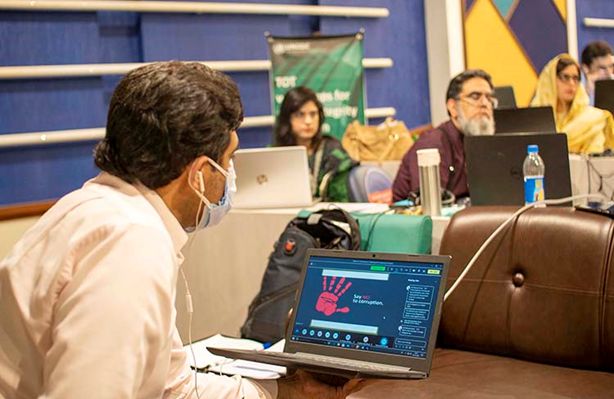
01 September 2022 – As part of ongoing efforts to equip young graduates with ethical mindsets and empower them to become a driving force for ethical business, the United Nations Office on Drugs and Crime (UNODC) today convened an online gathering of lecturers and business practitioners from its Global Integrity Education project in Kenya, Mexico, and Pakistan. Since being launched in 2019, some 350 university lecturers from the three countries have been trained on the UNODC university modules on Ethics and Integrity and Anti-Corruption. The lecturers, in turn, delivered the modules to more than 16,500 students. 40 business practitioners, invited as guest lecturers, have also delivered lectures, providing a practice-oriented approach to teaching.
The online meeting was an opportunity for lecturers and business practitioners to connect, share their experiences and discuss the challenges they faced in teaching the university modules. "At my university," noted one of the participants from Tec de Monterrey in Mexico, "we have teacher training courses and UNODC has been a fundamental pillar in incorporating business organizations as training partners." Prof. Syed Husain Haider from the Lahore University of Management Sciences (LUMS) meanwhile highlighted the key successful interventions of the project in both academia and the corporate sector. "Considering the enhanced acceptability in teaching topics related to integrity and anti-corruption, as well as attracting the interest of stakeholders not currently part of the project, the impact of this initiative has been notable," he emphasized in his opening remarks.
UNODC also used the occasion to present the results of a pilot survey on the impact of teachings and the upcoming report on monitoring, evaluation, and learning, which will help lecturers understand the impact of their work. Commenting on the results of the pilot impact survey, lecturers agreed that the teaching had a positive effect on students and reported that some of those taught were also seen to apply the learnings on ethics and integrity outside of the classroom.
When asked about their satisfaction with their participation in the Global Integrity Education project, all lecturers and business guest lecturers rated their experience as excellent or very good. The challenges brought up during the meeting included time constraints and the difficulty of convincing students that the modules relate to real-life situations. Webinars with business practitioners were suggested as a mitigating measure to make the teaching more practice oriented. In addition, lecturers put forward the idea that the teaching of ethics and integrity should be complemented with, for example, community work to allow students to develop an ethical mindset and to practice their values through experiential learning. Participants also suggested increased interactions between business and academia.
Business practitioners delivering guest lectures to students on ethics, integrity, and anti-corruption present at the meeting found the collaboration between universities and the business community to be a critical component for building students’ employability and entrepreneurial skills. They confirmed that the project approach provided a platform to foster future ethical leaders.
“Through our participation in the project, as compliance officers, we go back to the basics of compliance and the importance of ethics in a company,” noted Sonia Nophal, Head of Compliance at Bayer Mexico. “As guest lecturers for the Global Integrity Education project, we see that as employees, we have the same questions as students around ethics, but that they can see the case studies from a different perspective that allow us as a company to analyze their opinions and implement activities to strengthen business integrity from a new and fresh perspective,” she added.
This aspect was echoed by another business practitioner from Mexico, who added that “through our participation in the project, compliance officers in our company have reviewed their compliance programme to focus on ethical values and adopt a more human-centred approach”.
Going forward, UNODC will establish Ethics Ambassadors’ networks in the project implementing countries to increase the interaction between students, lecturers, and business practitioners, and pilot on-the-job anti-corruption training in businesses based on the university modules.
The UNODC Global Integrity Education project is funded by the Siemens Integrity Initiative.
