Kuala Lumpur, Malaysia, 5-7 February 2025—Corruption has a disproportionate impact on the poor by increasing costs and reducing access to services. It erodes trust in government, undermines investment and stifles economic growth.
According to the World Bank, corruption remains one of the top challenges facing Malaysia as it prepares to achieve its goal of attaining a high-income and developed nation status while ensuring sustainable shared prosperity. In line with resolution 10/12 adopted by the Conference of the States Parties to the United Nations Convention against Corruption at its tenth session in December 2023, UNODC collaborated with the United Nations Global Compact and the Organisation for Economic Co-operation and Development (OECD) in developing the publication “A Resource Guide on State Measures For Strengthening Business Integrity”. The publication provides States with a framework for encouraging business integrity by identifying and implementing an appropriate mix of sanctions for misconduct and outlining good practices for incentives. The approach of strengthening incentives to enhance business integrity has garnered interest in various countries, including Malaysia, and has been integrated into national policy and anti-corruption frameworks.
In May 2024, Malaysia launched the National Anti-Corruption Strategy (NACS) 2024-2028, replacing the 2019-2023 plan. NACS outlines critical strategies focused on promoting integrity, transparency and accountability across diverse sectors, including both the public and the private sector in Malaysia, and incorporates a dedicated strategy on incentives. UNODC was engaged in the consultation processes for the development of this new strategy, providing guidance and insights during the review process.

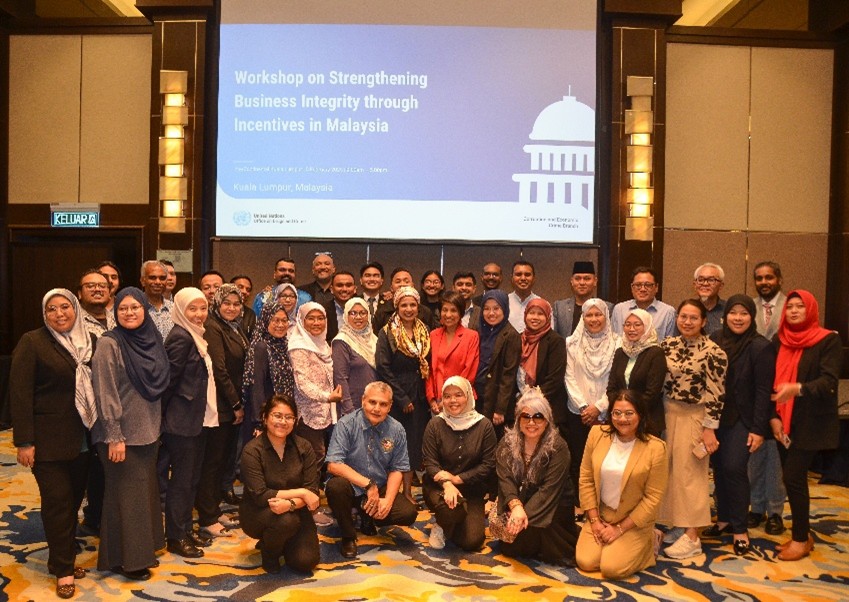
To better understand the opportunities and challenges of implementing incentives for business integrity in Malaysia, UNODC held a multi-stakeholder workshop on 5 February 2025 in Kuala Lumpur. The initiative emerged from, inter alia, the critical need to confront significant inefficiencies and systemic corruption risks that have been identified through financial audits and investigations by the Malaysian Anti-Corruption Commission (MACC), involving the private sector and government-linked companies. During the forum, UNODC spoke on the critical role incentives play in enhancing business integrity. Participants were taken through the resource guide and engaged in case studies that would be of relevance to the country. Deliberations revolved around the major corruption risks to business integrity in Malaysia and proposed solutions to the identified challenges. A key takeaway was the need for collective action and capacity-building for private and public sector representatives.
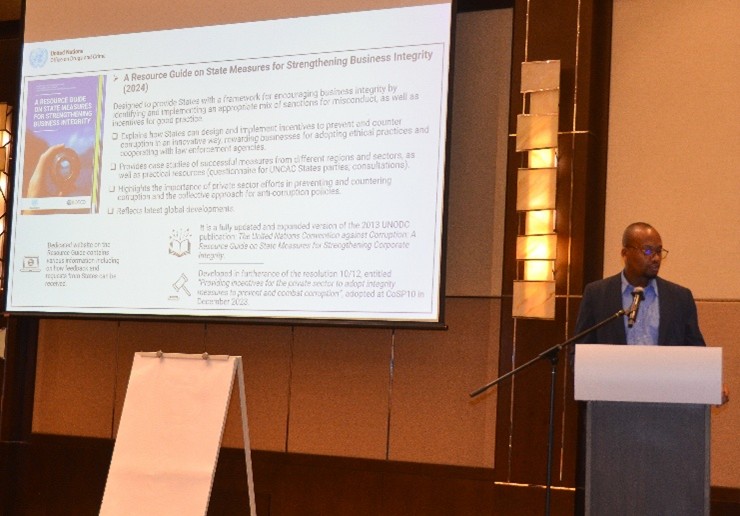
The forum saw the participation of representatives from the public sector, including MACC, the Securities Commission and Malaysia's listed stock exchange operator, Bursa Malaysia, in addition to civil society and private sector representatives.
During her presentation on incentives for the private sector under Strategy 5 of NACS, Ms. Shamina binti Ali, Head of MACC’s Coordination of the National Governance Planning Division stated, “Incentive schemes are a new initiative for anti-corruption compliance in Malaysia and the implementation of the corporate tax rebate for private companies that implement anti-corruption programmes has involved negotiations with various government agencies, training partners, ministries and has been a steep learning curve”.
UNODC also held meetings with project partners in Malaysia on 6 and 7 February 2025, including MACC, the Association of Certified Integrity Officers (ACeIO), the Centre to Combat Corruption and Cronyism (C4 Center) and Transparency International (TI) Malaysia. As Malaysia continues to strengthen its anti-corruption framework, collaborative efforts across various sectors remain crucial.
