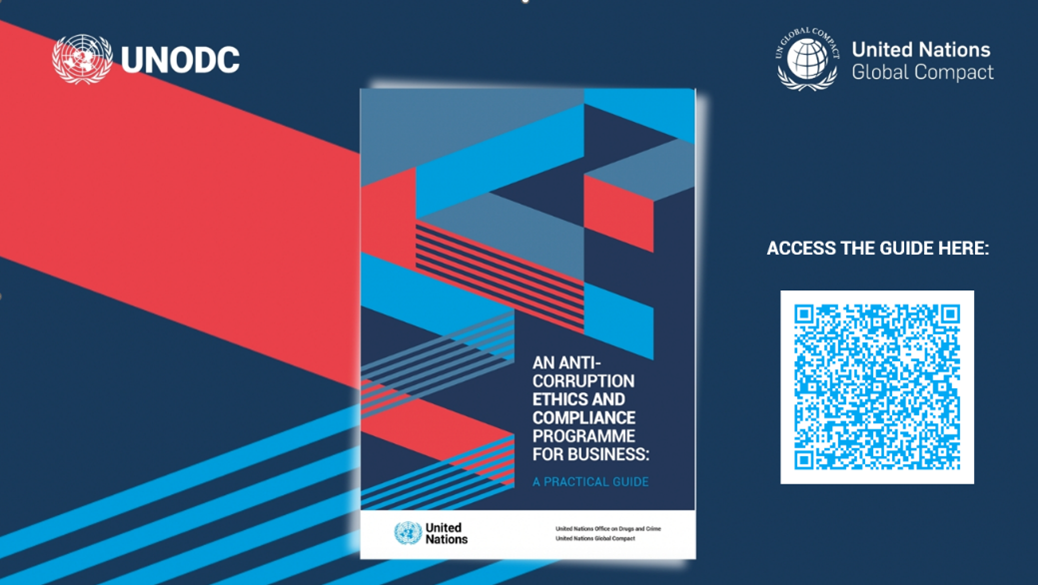
Vienna - New York, March 2026 — A newly updated edition of the publication An Anti-Corruption Ethics and Compliance Programme for Business: A Practical Guide has been launched, marking an important step forward in global efforts to strengthen business integrity.
Developed jointly by the United Nations Office on Drugs and Crime (UNODC) and the United Nations Global Compact (UN Global Compact), the guide builds on the original 2013 publication and reflects more than a decade of evolving challenges, good practices and innovations in business integrity.
The new publication provides a globally applicable standard for anti-corruption ethics and compliance programmes for businesses.
It sets out the key elements of such programmes and presents them in concrete, actionable steps that can be applied across sectors and contexts. While relevant to companies of all sizes, the guide also includes tailored recommendations for small and medium‑sized enterprises (SMEs).
The publication was shaped through a Think Lab on Business Integrity involving more than 25 companies worldwide, which contributed practical insights and real-world experiences.
Additional input from governments, civil society organizations and several global anti-corruption forums further informed its development.
The guide is grounded in international norms, including the UN Convention against Corruption (UNCAC) and UN Global Compact Principle Ten.
The updated guide introduces several innovative features:
Practical tools, such as case studies, checklists and step‑by‑step guidance that support implementation and continuous improvement.
Beyond the private sector, the guide also serves as a valuable benchmark for governments.
In line with Conference resolution 10/12 on incentives for business integrity, it can support government efforts to assess the effectiveness of anti-corruption ethics and compliance programmes in companies.
Such assessments are important for governments to determine which companies may qualify for incentives, for example, in areas such as subsidies, licenses, public procurement or export credits.
Incentives are financial, regulatory or reputational advantages and are intended to encourage companies to prevent and counter corruption and other misconduct effectively.
