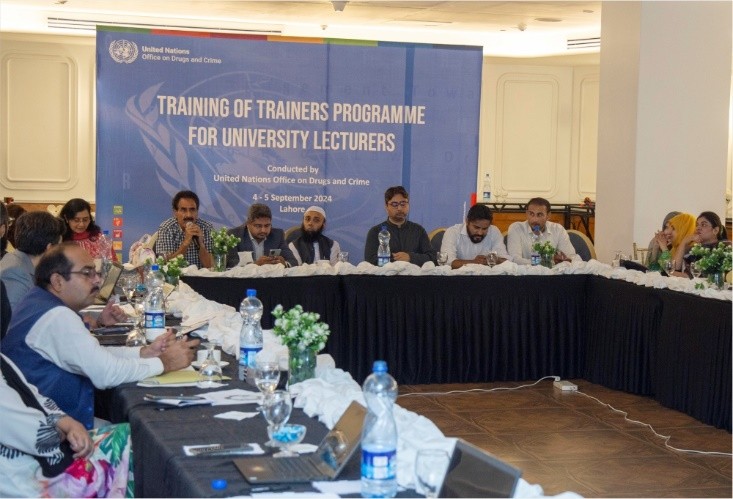
Pakistan’s business environment has long been plagued by unethical practices, undermining trust and stifling economic growth. A key factor is the lack of structured integrity education in universities, leaving graduates ill-equipped to navigate ethical challenges at the workplace. To address this, the United Nations Office on Drugs and Crime (UNODC), under the Global Action for Business Integrity project, leveraged the impact of the Global Integrity Education project to empower educators and inspire ethical leadership.
UNODC launched two training for educators programmes, equipping 84 university lecturers with the skills to teach integrity and anti-corruption principles. Over four years, these educators have delivered tailored integrity modules to 30,000 students. Juhinah Batool Asif, a lecturer at the National University of Computer and Emerging Sciences, highlighted the training’s impact: “The training was incredibly enriching, offering valuable insights into improving our teaching methods and effectively delivering lessons on integrity and ethics. Participating in the training has enabled me to learn, explore, and integrate new techniques, ultimately boosting my career and helping me nurture my students”.
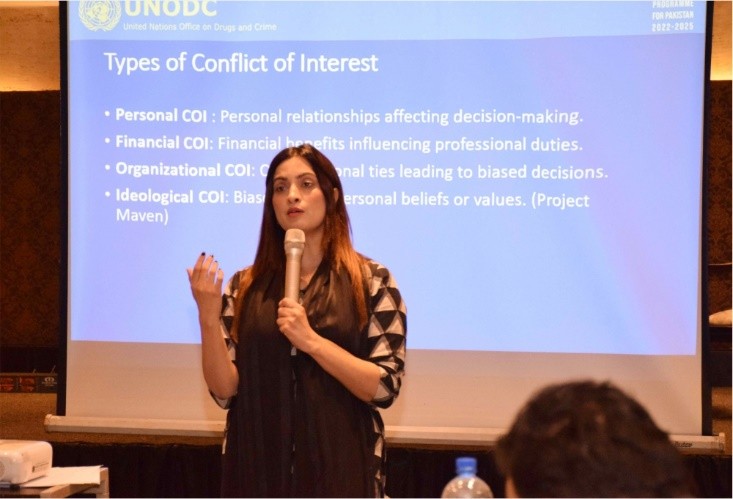
The initiative’s success sparked demand for more integrity education. Following a 2024 session, Punjab University’s Pharmacy Department requested a similar programme, leading to a second training of educators in 2025. Participants also expressed interest in training colleagues, creating a multiplier effect.
Beyond academia, over 20 students trained through the programme have become ‘Ethics Ambassadors’ — champions of integrity who actively promote ethical practices in their workplaces and communities, creating a ripple effect of positive influence. Many have contributed to on-the-job integrity training influencing corporate practices. Students engaged through this project have also represented Pakistan globally, including at the Private Sector Forum at the tenth session of the Conference of the States Parties (CoSP) to the United Nations Convention against Corruption (UNCAC), the Good Practices Forum in Mexico, and the Coding4Integrity Hackathon in Qatar, Good Practices Forum in Mexico, and the, showcasing their commitment to ethical leadership. To ensure sustainability, universities like the University of Lahore have integrated UNODC’s modules into formal curricula, setting a precedent for others. This institutionalization ensures integrity education continues beyond UNODC’s direct support, creating a self-sustaining model.
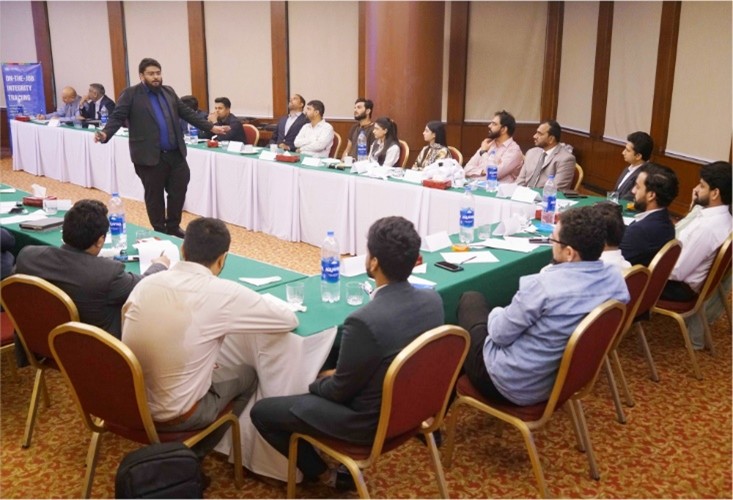
By transforming educators into integrity champions, UNODC is embedding ethical practices in Pakistan’s corporate culture. As Imran Tariq, Assistant Professor at Punjab University, noted, “The engaging sessions made complex concepts easier to teach, inspiring students with valuable insights.”
