Before she had the opportunity to take a training offered by the United Nations Office on Drugs and Crime (UNODC) Global Integrity Education project, Mahnoor, a university student in Pakistan, had barely studied integrity and ethics. Commenting on the extensive hybrid training programme of group activities, presentations, motivational lectures, case studies and open-house discussions, Mahnoor stated that “this project has equipped me with the skills and tools necessary to identify and prevent corruption risks and to promote a culture of transparency and accountability.” The UNODC training provided Mahnoor with the tools to develop decision-making strategies that take into account ethical ‘right’ and ‘wrong’ choices, deviating from decisions weighted by economic pros and cons, and these have helped her to find solutions to ethical obstacles. Following the UNODC training programme, Mahnoor was afforded an internship opportunity at a transport company called Daewoo Pakistan, as an ‘ethics ambassador’, to practically implement what she had learned.
As shown by the testimony from Mahnoor and echoed by several other university students who participated in the training, university-level education on integrity and ethics plays a crucial role in shaping the ethical mindsets of future leaders, citizens and professionals. When the private sector becomes a partner in it, the impact and success of promoting business integrity is maximized.
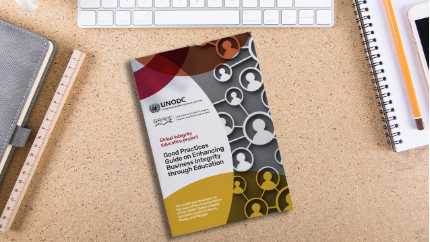
The UNODC Global Integrity Education project - funded by the Siemens Integrity Initiative – through which students like Mahnoor received training was implemented in Kenya, Mexico and Pakistan between 2019 and 2023 to build the capacity of youth as future ethical business leaders. UNODC has built on the knowledge, experiences and results from the project to develop the Good Practices Guide on Enhancing Business Integrity through Education. The guide provides universities, the public and private sectors, civil society and youth with recommendations on how to collectively engage in educational activities that promote a culture of rejecting corruption while strengthening business integrity, through the collaborative engagement of the private sector and academia.
