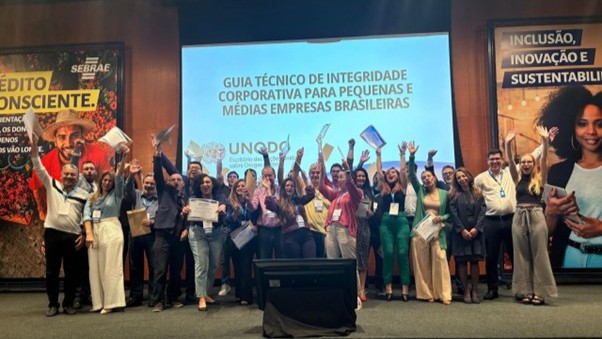
Corruption and integrity risks pose significant challenges to good governance, undermining public trust and government efficiency. Recognizing these challenges, São Paulo’s Municipal Comptroller’s Office sought assistance from the United Nations Office on Drugs and Crime (UNODC) to identify and mitigate corruption risks across the municipal government, private suppliers and its value chain.
Under the Global Action for Business Integrity project, UNODC engaged both private and public sector representatives and developed a technical study on promoting integrity based on risk according to the new Brazilian Procurement and Administrative Contracts Law (Law No. 14,133/2021). The study introduced anti-corruption good practices in public procurement through two key components: a risk-based methodology to identify and prioritize integrity risks and strategies to align the Brazilian Procurement and Administrative Contracts Law with the United Nations Convention against Corruption (UNCAC).
To help implement the study results, UNODC leveraged feedback collected during its development to launch a complementary booklet featuring a risk matrix. The tool provides step-by-step guidance to public officials seeking to map and mitigate integrity risks in bidding and contracting processes. Using these tools, public officials can now suggest integrity and due diligence measures to private sector suppliers and companies can enhance their corruption risk assessments. The Comptroller General called the technical study “a crucial source of insights and data that allowed us to develop and implement effective strategies in our city”. Building on the study, UNODC trained small and medium-sized enterprises on how to identify and mitigate corruption risks. Patrícia Lopes, a participant in the training, praised its impact, explaining: “We've seen a tender requiring the bidder to have knowledge of compliance and a corruption risk mitigation plan. As we had the opportunity to take part in this course, we already have the know-how and something to present, which will even serve as a portfolio for our company.”
By tackling integrity challenges from public and private sector perspectives, UNODC has fostered a dynamic exchange of knowledge, improving public procurement processes and empowering companies to compete fairly.
